How do you capture a society on the brink of destruction? How do you tell a story where tension is the main driver from the very first until the very last minute? How do you convey human desperation?
These are all questions which Sidney Lumet answered in 1975 with Dog Day Afternoon, a classic of New Hollywood and a movie that still to this day continues to surprise me with its ferocity, heart and compassion. A movie that should not work but does, and one that – in today’s age of people obsessively striving for soulless perfection via soulless machines meant to strip us of our individuality – reminds us of the importance of human fallibility that lies at the core of our existence.

It all starts with the setting.
Sunny Brooklyn, sweltering heat. Late afternoon. Summer.
And then – all it takes, is for one single thing to go wrong.
That’s the way Lumet kicks off the true story of bank robbers John ‘Sonny’ Wojtowicz and Salvatore ‘Sal’ Naturile played respectively by Al Pacino and John Cazale. What goes wrong is that right off the bat their driver chickens out and leaves them to their own devices. That’s step one in building tension.
Step two is both robbers are completely incompetent.
Incompetence is an important factor. It is a manifestation of desperation and adds to the sense of danger that soon overtakes the bank employees – because anything can go wrong. These guys are amateurs with loaded guns. We, the audience, realize that despite feeling somewhat sympathetic towards Al Pacino’s affable Sonny, there is real stakes involved, real people are under threat and even the slightest mistake can cause Sal to rake the room with gunfire.
We feel conflicted. Tension builds.

The third rule to Sidney Lumet’s masterclass in building tension is the real time display of the action that unfolds before our eyes. The robbery is immediate and the escalation builds over the course of the movie’s runtime. What we see is what we get. What we see is a real time domino effect of every decision Sonny and Sal make while confined to the limits of the bank. The single location adds to the pulsating narrative. We are watching cinema at its most stripped down. Actors, a single location and a camera that knows the key to the audience’s soul – and that is by focusing on Al Pacino’s eyes.
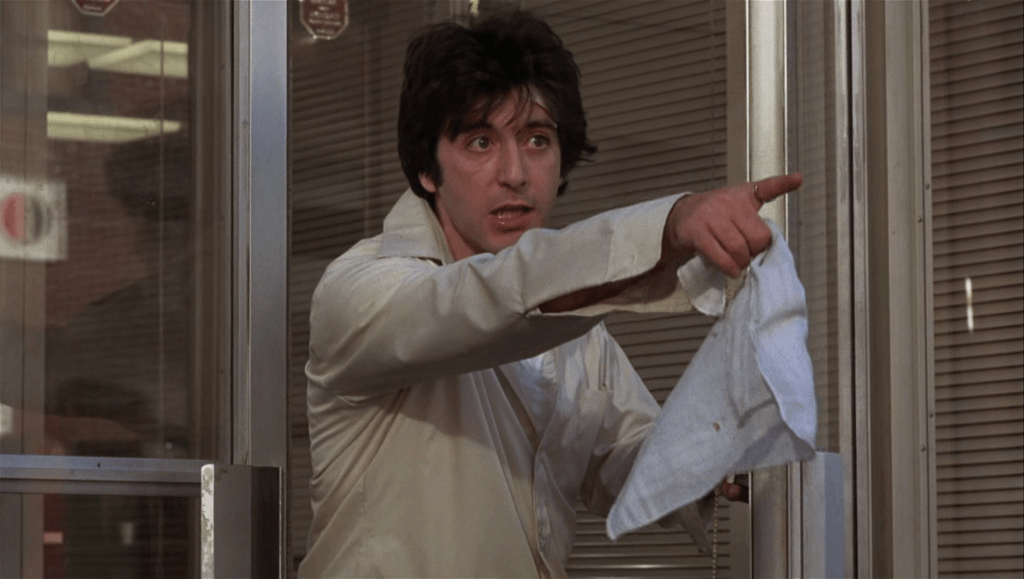
Pacino’s Sonny is all eyes. He is the quintessential film protagonist – wide-eyed, haunted. His eyes dart across the frame communicating everything we need to know about the situation gone sour. So much of what Dog Day Afternoon is about, human desperation and a widespread sense of abandon and isolation, is projected onto Pacino’s face. We see the expression of fear turn into false, self-imposed confidence as Sonny tries to navigate the robbery and subsequent hostage situation all by himself. The world falls on his shoulders. Then the confidence fades and the realization of impending doom sets in. For Sonny it is Vietnam all over again.

Having famously refused to view the real footage of the televised robbery that took place in 1972, Lumet stages the confrontation with the police and the media by giving us a complete map of the territory. We see the positions of snipers, helicopters circling around, police barricades and off-duty cops ready to step in with their guns and badges. But most importantly we see the crowds of people who come to watch the spectacle. At times, Dog Day Afternoon feels like a concert movie ala Woodstock because of how much attention it pays to the atmosphere surrounding the movie’s central narrative. Lumet – who would go on to critique the desensitized, money-grabbing and power-hungry media system just a year later with Network – reminds us that everything is for sale, including the uncertain fate of the people stuck inside the bank. It is all about the crowd gathered outside. They’re the spectators – they decide whether you have a chance to survive or not. And for a while Sonny holds this realization to his advantage as he parades outside the bank, waving a white flag, taunting the policemen with their guns drawn. In his desperation he begins to feel mighty powerful. The crowd responds to him – a regular Joe fed up with the world, taking on corporate America all by his lonesome – and by doing so, they keep him and Sal alive.

But nothing lasts forever because humans make mistakes.
Sonny gets the wrong information about when the money is deposited into the bank which results in a semi-empty vault.
Sonny then burns the bank register and that causes smoke to exit through the ventilation system which in turn alerts a neighboring business.
At the half-way point, a policeman tries to get into the bank through the back door and that causes Sonny to take a shot at him which further escalates the situation.
Shit happens.
The world is fascinating because of the endless variables at play. Dog Day Afternoon gets it. It catches the beauty of people in their most imperfect moment. It is a film of errors where even the police captain (played by Charles Durning) who orchestrates the negotiation with Sonny, comes off as a friendly and helpless idiot, unable to keep his own men in check and provide Sonny with the answers he needs to hear to remain calm. Everybody’s in the same boat. Everybody’s sweating, tired and eager to go home and feel safe, feel loved. But mistakes prevail and prevent that from happening.
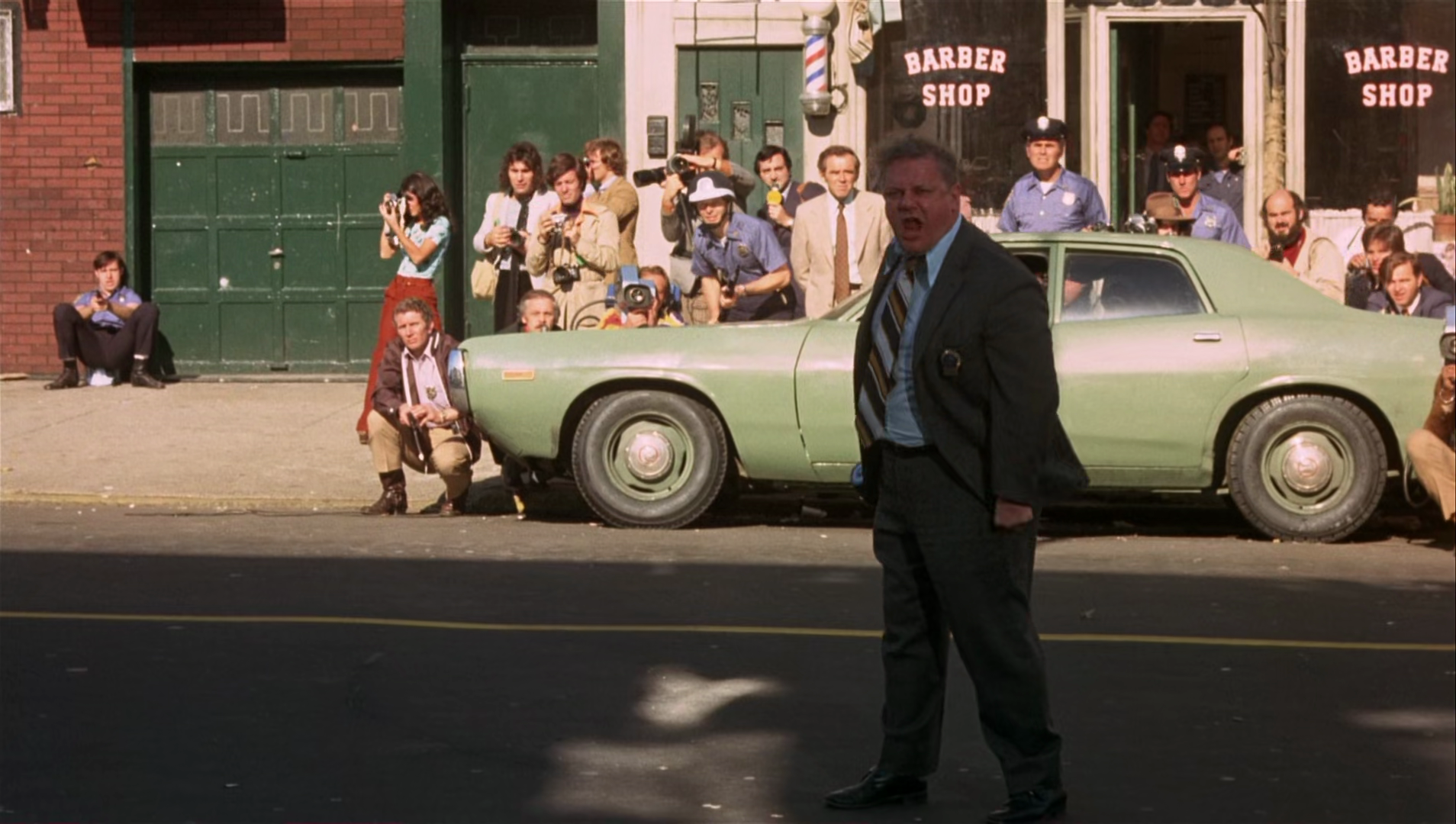
Lumet’s insistence on improvisation (a rarity for a director who was known for sticking to the script and the practice of interminable rehearsals prior to principal photography) in this case adds to the experience of watching the situation slip through the characters’ fingers. Whenever Sonny goes outside to negotiate it is clear as day that neither Pacino nor Durning have any idea what the other one is going to say. They’re both navigating the dangers of the situation as if their own lives depended on it, fully aware of each misspoken word and the cost behind it. Durning repeatedly bites his own tongue; when he’s supposed to answer Yes he says No and vice versa. Meanwhile Pacino raises his voice, fixates on something and calls it out. He calls out the cops refusing to holster their weapons, he calls out the cameramen for getting too close to him, and finally he calls out the crowd for not being loud enough. That’s when the famous ‘Attica, Attica’ cry happens. It is a riveting display of pure improvisation for the sake of building tension.

Improvisation further deepens the tension, and the tension further deepens the relatability of the world the film is busy depicting. A film like Dog Day Afternoon is timeless not because of its entertainment value but for the world it constructs and deconstructs. It is a world of characters who live and breathe by the minute. The frantic pace of the narrative is matched by the slow reveal of the characters’ deepest secrets to the point that each minor event becomes a turning point for the rest of the film. When it is revealed that the security guard has asthma, Sonny must stage his release while also taking a huge risk himself. And when the bank manager almost faints because of a lack of insulin as a diabetic, Sonny must find a way to get a doctor in there.
Sal’s big reveal is that he is ready to kill the hostages and himself if need be. He, unlike Sonny, is fully committed to this idea. And when it dawns on Sal what he’s capable of doing, Sonny realizes that he will have to contain and deal with him, too. Because Sonny, unlike Sal, has love in his heart and as long as that love is there, nothing can get him to end it all.

When it is made clear to us that Sonny is a homosexual and the reason as to why he is robbing the bank is to collect enough money for his partner’s sex change operation the movie kicks into another gear, beyond what we thought was possible. It turns Sonny into an ally and an enemy all at once. All of a sudden the crowd shifts in their view of him as the media ramp up the coverage of his personal life to further enrich the spectacle. Lumet now builds tension by adding layers to his protagonist with Sonny standing to lose everything; the little money he’s robbed as well as the person he loves. But Sonny’s drama and his personal dilemmas unfold in silence. That’s another thing Lumet knows all about – music undermines tension and takes away from the palpability of the action on the screen. Without music to muffle the drama and risk romanticizing it, we feel naked, exposed, just like Sonny when he stands outside with hundreds of guns trained on him.
As the situation gets way too out of hand, we feel submerged in silence. There is no escaping it. We have to sit there and listen as Pacino dictates Sonny’s will to one of the hostages who’s writing it all down. Hearing Pacino accept the possibility of death is the culmination of everything that preceded the scene. Every loud moment of the movie comes down to this long sequence of Pacino staring beyond the camera’s gaze, looking for the right words to sum up his character’s wishes and desires. It is one of the most heartbreaking scenes I can think of.

The film’s tension is representative of something bigger than just the events on screen and the ridiculous true story of a gay man who botched a robbery, cost his partner’s life and came away empty-handed. It is the defining film of a world for show, a world where people suffer in solitude and injustice, and when they don’t, they’re tarred and feathered, their suffering reduced to a gag we can watch on TV as we sit down to dinner. The spectacle carries real consequences and involves real people but we would never know it because the crowd will always cheer no matter what and their screams will not translate into anything above a whisper with the passing of time. Pacino’s iconic ‘Attica, Attica’ cry for help is a curious moment that we now look back on and scratch our heads, wondering, what was all that about? And then some of us will look it up on Wikipedia, but the majority will continue on with their day, because why risk ruining it? The crowd will disperse anyway, the pain and suffering will be replaced by some more pain and suffering, so what the hell does it matter? Having a conscience leads to too many headaches. That’s why Sonny was a bad bank robber. He was human.

 LIFEFILMLOVE