
So many documentaries today seem concerned with the subject of death.
In a way, documentaries have become synonymous with acts of depravity and savagery, often serving as background content on major streaming platforms. “The true story of…” and it is usually the story of a couple stabbed or shot to death by their six-year-old, or the mysterious disappearance of little girls in some obscure region of the world, or the mystery behind a school teacher who moonlights as a serial killer and vanishes into thin air.
It almost feels as if documentary filmmakers are being prodded to cater to an algorithm that will guarantee repeated viewings of their film in-between episodes of Spongebob and the latest Marvel product.
There is a need to tell stories, and often the importance of these stories is dictated by whether or not death is involved. To be taken seriously is to take stock of someone’s death. For proof, seek out Werner Herzog’s Grizzly Man or Joshua Oppenheimer’s The Act of Killing. It is seemingly through episodes of violent death that we get a closer look at someone’s life. But what if death weren’t concerned at all? What if life depicted in a documentary was just that – life as it is, not a biopic, not a rags-to-riches story, but an honest account of people making a living and finding purpose in their ways?

That is the premise to my favorite documentary, Happy People: A Year in the Taiga directed by Dmitry Vasyukov and produced by Werner Herzog; a film solely focused on the happiness and integrity of its subjects. Originally a four-part television miniseries shot by Vasyukov, the footage was eventually edited into a feature with Herzog stepping in as the narrator and producer.
It is the story of men, women and children living in the heart of Siberia, in the village of Bakhta, where access is only possible by air or by boat – but only in the summer, when the Yenisei river isn’t frozen. It is a document of survival about a group of people cut off from the rest of the world. Russia, in this case, is nothing but a mere abstract idea – a geographical term that does not, in fact, reflect the experience of the people involved in the making of this movie. Bakhta and the vast wilderness surrounding it belong to another realm where things such as government, social security and taxes have no claim.
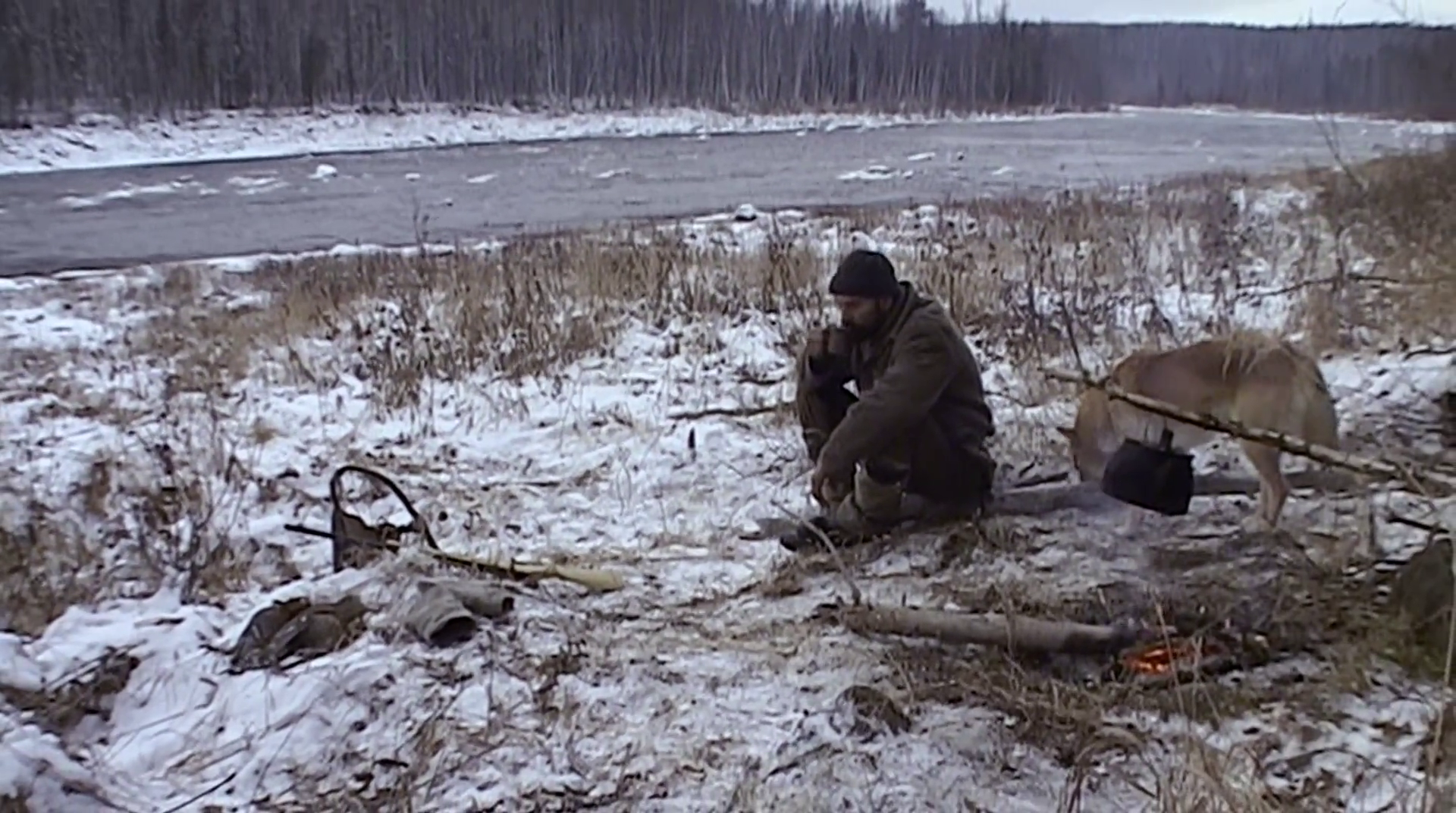
The film follows different members of the village over the period of one year. They are primarily hunters, trappers and fishermen. But in Bakhta a profession is not of great relevance. What matters is surviving. From the youngest to the oldest, every villager is brought up to survive in an environment where summers are torrid and unbearable and winters are merciless, with temperatures dropping well below -50 degrees Celsius. It is a land of extremes but with people content with what they have, what they share with each other and, above all, with nature.
Vasyukov’s film is a tale of four seasons and goes in depth to show us how life flows through each of them. In Bakhta preparations for the freezing cold last all-year round. Food must be stocked, pelts must be collected, fish must be smoked and order must be preserved ; order in the generational sense as Baktha’s inhabitants ensure to pass on the necessary wisdom from generation to generation and thus guarantee the survival of sons and daughters born into this world of extremes. Order and generational wisdom are the primary tools for survival in Baktha where knowledge is considered to be an invaluable asset, one that can mark whether the village makes it past the winter or ceases to exist in the blink of an eye.

In Baktha one soon learns how to deal with mosquitoes with the help of makeshift repellant; a mixture of oil and tar extracted from the bark of birch trees is effectively smeared on the skin of humans and dogs alike. In Batkha you have to known how to build your skis using the right wood in order to have a chance at crossing the knee-deep snow without dying of exhaustion (which will happen if you attempt to use the heavier, commercial ones). In Baktha you must limit yourself to the use of primitive tools such as the lantern to attract fish at night and a trident to spear them with. In Baktha nature sets the rules for you – not the other way around.
The Taiga is merciless, but through its cold brutality it allows for people – those brave enough to settle there – to come to terms with the deepest outlook on life, far away from the hustle and bustle of cities. Vasyukov doesn’t search for big philosophies – the subjects he follows and interviews in and around the village are given plenty of room to express themselves the way they want to, not the way he requires them to. It is an act of witness to the ways of survival – it is also an exploration of men and women embracing the extreme, which is what probably attracted Herzog to the project.

Herzog, an enthusiast of the idea of the ‘ecstatic truth’ – namely, the heightened interpretation of events such as made-up facts, false storylines and self-made dramatic beats which he often peppers his films with – narrates Vasyukov with the devotion a stranger from a faraway land whose ways couldn’t be more different than those of the subjects he’s narrating about. Herzog clearly saw in Happy People a chance to confront himself with a world where natural cruelty meets, oddly enough, the human need for harmony. Yes, harmony – because the people of Baktha hail from all over to experience this place (one of the trappers is the nephew of the famous Russian filmmaker Andrei Tarkovsky who came to work in the area in the 1980s and write about it, and ended up settling there for good), and realize their fortune in living like woodsmen, not having to account for anything outside their own vast, untamed stretch of land. Their own heaven and hell.
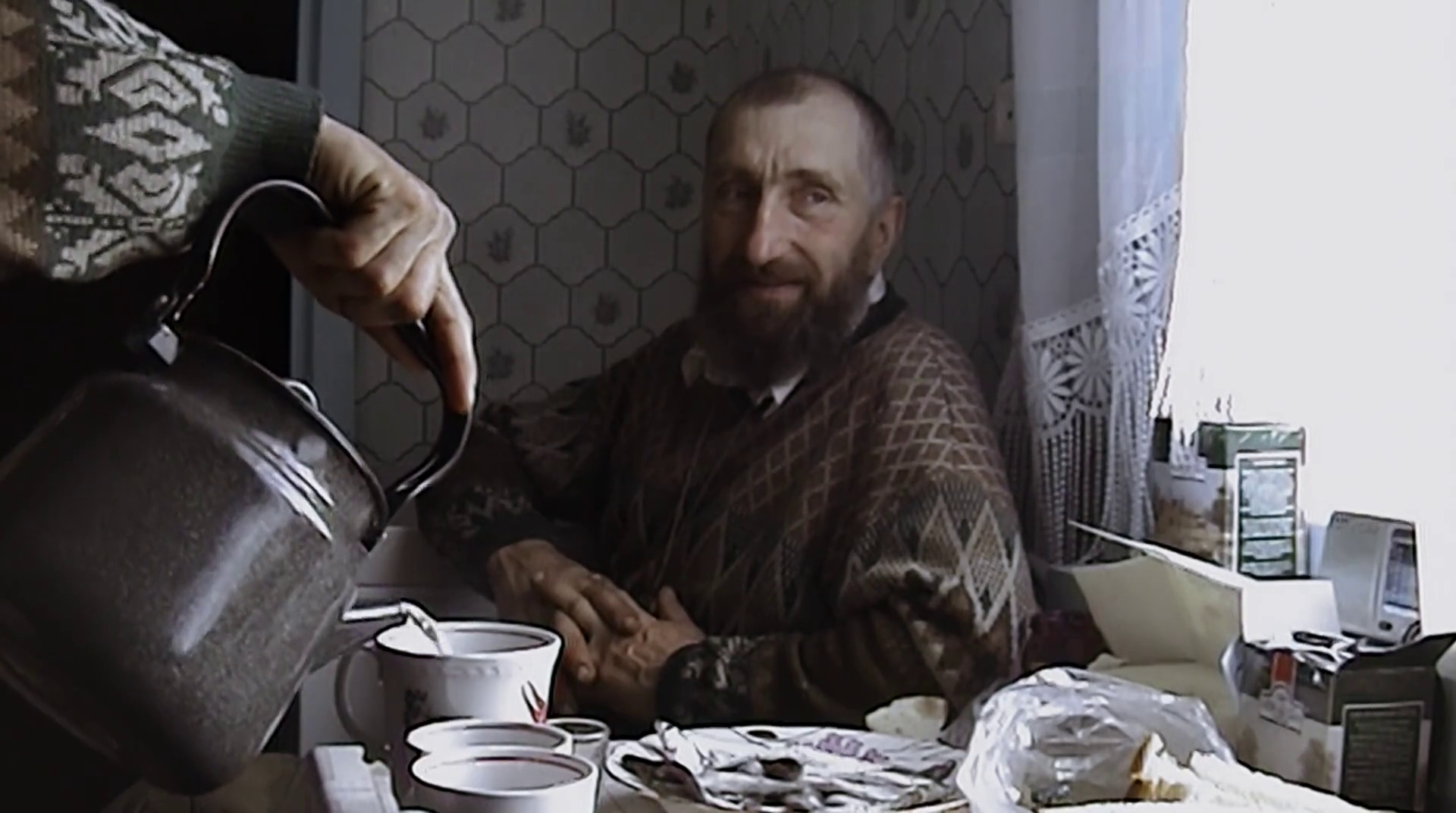
But not everyone had a choice in coming to Baktha. Some, like Gennady – one of the most experienced trappers and leading characters of the documentary – were sent out into the wilderness by the Communist regime in the 70s to continue trapping for the state. “They gave me traps, some money, issued a gun. They showed me the site and dropped me from a helicopter. Without a radio, without anything. They promised to bring more stuff on New Year’s Eve…but they didn’t bring anything at the promised time.”
In Gennady Herzog and Vasyukov find a man at peace with his origins, the way life just took its own, unpredictable turns and the struggle at the root of his current existence. “It’s a long story,” he says placidly. “But I survived. I thought I was a hell of a seasoned trapper. But when it really came down to it, it turned out I was a complete novice. Well, matter of fact, I don’t think I blew it.”
Is it just folly that makes men like Gennady accept their fate? Or is there something more to it? This seems to be the recurring question in Vasyukov’s film as every person in it, much like Gennady, has come to accept the fact that anything outside of our own determination and will will always remain beyond our control. For us, similarly to Herzog and Vasyukov, their sensibilities are foreign, their outlook bare and yet simultaneously twisted. The film makes simplicity look complex.

The harmony and simplicity extend to the way men are dependent on dogs. This relationship is studied at length by Vasyukov who makes sure to capture the dozens of dogs at the service of their owners. It is a relationship chiseled in ages of survival, of co-dependency, of men and dog saving each other’s life, protecting each other from the dangers of the Taiga.
You can tell a lot by how a man in Baktha treats his dog. A dog will feed him, provide him with prey and come to blows with a bear if need be. A man, in turn, will teach the dog how to carry out its duties, how to sniff out traps and remain impassive in the face of the brutal weather conditions.
By focusing on this relationship between man and animal, Vasyukov hints at which of the characters we should side with. One of the main trappers, in fact, scarcely feeds his dog with scraps of fish. Herzog, the narrator, picks up on it and comments, “It is conspicuous how little he gives his dog for breakfast.” It is a comment that appears near the end of the film – by this point, after having witnessed how important dogs are in the survival of our protagonists, the viewer, much like Herzog himself, is shocked at the sight of such negligence. This minor observation helps in adding depth to the world we’ve been introduced to. Even in Baktha there is a hierarchy; the perception and status are based on one’s treatment of dogs.

In a wonderful scene, Gennady recalls the time that his beloved dog, a bitch named Smoky, saved him and the village from a bear. In the story he tells, Gennady paints a vivid picture of the bear attack and how Smoky stood her ground and fought back while other dogs ran away in panic. Smoky’s efforts save Gennady from certain death. Her timely intervention allows the hunter to steady his rifle and take a shot. After killing the bear, Gennady finds himself holding Smoky in his arms, running to the doctor in town, pleading for help as he realizes that her belly has been slashed open by the bear’s claws. A few moments later, Smoky dies in his arms and that’s that. In the laws of nature, this should be an unsurprising occurrence. For a man like Gennady, Smoky’s death should be treated like the result of nature in form of the bear dictating its terms, reminding people of what they stand to lose. But for Gennady, Smoky’s death is much more than just another lesson learned. We watch as he clearly struggles to remain composed and maintain his even tone of voice. “I was overwhelmed with sadness,” he notes. Coming from a stoic man like Gennady, it is a profound confession. More than most people care to admit in a place like Baktha.

Vasyukov’s film is a beautiful balancing act of encapsulating the happy, blissful existence of our characters while simultaneously reminding us what is at stake and how much people stand to lose in the heart of the Siberian Taiga. Your dog can be mauled to death by a bear; your kids can drown while skating across the remaining layers of ice on the Yenisei; you can remain without shelter and freeze to death if a snowstorm catches you off-guard. But there is also something worse than that – and that is the fading of an entire people.
In Happy People, Vasyukov makes sure to include the story of the last surviving Kets, natives to the lower basin of the Yenisei river, a dying tribe whose collapse is inevitable, whose extinction is unstoppable.
The local Ket people are compromised of a very old woman and her family – a small group of men and women, all dealing with the same problem: alcoholism. Their sickness prevents them from being active members of the local community. They are unable to work consistently and can only handle small-time jobs like chopping and hauling firewood. But worst of all, they are unable to preserve their history and tradition. It is easy to lose one’s identity in the Taiga and that seems to be the crux of the film – the ease with which collective identity can vanish, a tragedy that has struck entire civilizations and is on the brink of wiping away the Yenisei Ket (according to a 2021 census, there is only 1,088 Kets left in Russia).
One of the more heartbreaking confrontations in the film involves a group of drunk middle-aged Ket men – all of whom are barely able to hold an ax to chop wood with. One of them, however, is lucid enough to assert the hopeless situation they find themselves in. “In the old days we lived in tents and the young learned from the old,” he explains. “Now a lot of that is forgotten. We’re drunk and we do odd-jobs.” As he says this, one of his friends, drunkenly shouts over him, “Hey, shut up! The Russians are to blame. Without the Russians, there wouldn’t have been vodka.” “No,” says the man. “It’s our own fault,“ he admits. “If you don’t want to live and work, what else can you do but drink?”

Having seen Happy People several times over the last years, my mind keeps regularly coming back to one image that feels etched in my brain. It is the image that appears near the end of the film – one of the trappers returning from hunting season to Baktha to celebrate Christmas with the family. It is the middle of winter, freezing temperatures, snow everywhere. The trapper rides his trusted snowmobile, sitting comfortable for the duration of the journey which takes numerous hours as there is more than 150 kilometers to be covered in very harsh conditions. The trapper’s dog follows behind, running. The animal runs the entire distance. Never being allowed to hop on the snowmobile, it continues running throughout the day and well into the pitch black darkness of the night. The camera holds on the dog as it continues to run, snow falling from the sky. This breathless determination, this fight of the animal to stay alive and stay close to its master is one of the most powerful images I have ever seen. It is a moving depiction of the spirit of survival against all odds, a breathtaking instance of an animal’s commitment to its duty to persist and survive; a duty it takes for granted but that in our eyes comes across as the biggest display of courage one could ever hope to attain. The courage to live.


 LIFEFILMLOVE